Radiators
Radiators, flow temperature and the 55°C design rule
Radiators are the part of a heating system you live with every day, and how hot the water inside them needs to be is a design choice rather than an accident. This page explains flow temperature, the 55°C rule in England and how it treats a boiler swap differently from a whole new system.
Last reviewed · facts read at source on 3 November 2026 · published by SEO-DONS LTD · sources
The basics
What flow temperature means
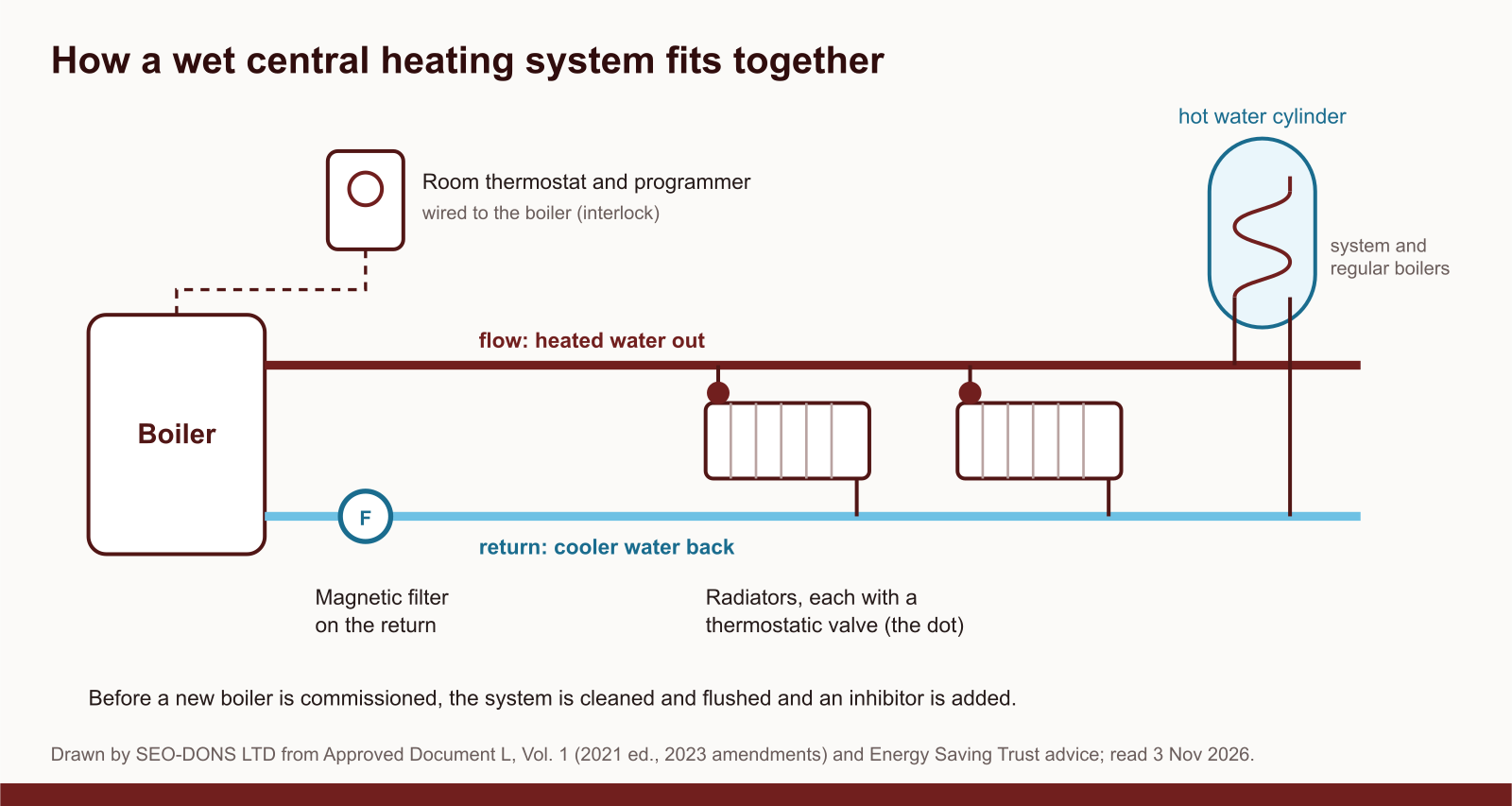
Water leaves the boiler hot, gives up some of its heat in each radiator and makes its way back cooler. The temperature on the way out is the flow temperature. The hotter it is, the more heat a radiator of a given size can put into a room; the cooler it is, the bigger the radiator has to be to do the same job.
That trade-off runs through everything on this page. A system designed around very hot water can manage with smaller radiators. One designed for a lower flow temperature needs more radiator surface, but the boiler works at a gentler temperature, and a condensing boiler only condenses, and so recovers extra heat from its flue gases, when the water coming back to it is cool enough.
The rule
The 55°C rule, and when it applies
Paragraph 5.10 of England's Approved Document L (2021 edition, with 2023 amendments) covers a wet heating system that is newly installed or fully replaced, meaning the boiler or other appliance, the radiators or other emitters, and the pipework. Such a system should be sized to work at a maximum flow temperature of 55°C. Where that is not feasible, it should be designed for the lowest flow temperature that is.
The 2026 edition, which applies from 24 March 2027, keeps the rule at its paragraph 4.10. What the rule does not cover is a very common job: a new boiler connected to the radiators and pipes already in the house. That job has rules of its own, set out below, but a 55°C redesign is not one of them.
Job by job
Which rules reach the radiators
| Rule | New boiler, radiators and pipes kept | Boiler, radiators and pipework all replaced |
|---|---|---|
| 55°C maximum design flow temperature (5.10) | Not triggered | Applies: 55°C or lower, or the lowest feasible design temperature |
| Sizing from a heat loss calculation (5.8) | Applies to the new boiler, which should not be significantly oversized | Applies to the whole system |
| A gas combi able to turn down to the typical heating load (5.9) | Applies if the new boiler is a gas combi | Applies if the new boiler is a gas combi |
| Thermostatic control in each room (5.20 and 5.22) | Applies when the boiler is replaced, where feasible | Applies, where feasible |
| From 24 March 2027 (2026 edition) | A whole-dwelling heat loss calculation; the old boiler’s output is not an appropriate basis for sizing (4.9) | The 55°C rule continues (4.10), and a combi should turn down to the typical mid-season load (4.11) |
Changing some radiators but not all?
The 55°C rule is written for a system that is new or fully replaced. If a quote swaps some radiators and keeps others, ask how the new ones were sized and at what flow temperature their output was worked out, so that every room still gets the heat it needs.
Sizing
The heat loss calculation comes first
Whatever the job, Approved Document L starts with the house rather than the boiler. Paragraph 5.8 asks for heating to be specified from an appropriate heat loss calculation and a sizing method, and for the system not to be significantly oversized. A heat loss calculation works out how much heat the house, and each room in it, loses in cold weather, and that is the figure the boiler and the radiators are matched to.
For a gas combi, paragraph 5.9 adds that the boiler should be able to modulate down to the typical heating load, so on an ordinary day it can run gently instead of firing up and shutting off. The 2026 edition sharpens both points. When only the boiler is replaced, a whole-dwelling heat loss calculation is appropriate and sizing from the output of the boiler being removed is not, and a combi should turn down to the typical mid-season heating load.
Room controls
Each room gets its own control
Radiators also carry most of the room-by-room control that a replacement brings. England's guidance expects each room to have its own thermostatic control once the boiler is changed, where that is feasible, and the usual way of providing it is a valve on each radiator, with a room thermostat in one room. If the existing valves are staying, ask for them to be checked as part of the job.
The heating controls page lists everything else that comes with a new boiler, including the four extra options for a combi.
Looking ahead
Lower temperatures and a future heat pump
Heat pumps work most efficiently when they only have to warm the water to a modest temperature, so the radiators matter a great deal when people weigh a boiler against a heat pump. A system already designed for 55°C or lower has made a start on that. If a heat pump is on your horizon, say so when the radiators are being sized, and read boiler or heat pump for the cost, VAT and grant side of the decision.
On the quote
What to ask for when radiators are involved
- Whether the job is a boiler swap or a full system replacement, in those words.
- For each new radiator, the room it serves, its size and its heat output at the design flow temperature.
- The design flow temperature itself, if the whole system is being replaced.
- How the boiler's size was worked out, and whether a heat loss calculation was done.
- Which rooms get thermostatic radiator valves, and where the room thermostat will go.
Then set the answers from each firm side by side with the line-by-line checklist, or get a heating quote for the radiators and boiler together. If the whole system is being replaced, central heating installation covers the wider work, and boiler types helps if the type of boiler is changing too.
Questions about radiators and flow temperature
Do I need bigger radiators with a new boiler?
Not because of the 55°C rule on its own. That rule applies when a wet heating system is newly installed or fully replaced, meaning the boiler, radiators and pipework, and not when a boiler is swapped and the radiators stay. Whether any radiator is too small for its room is something the heat loss calculation will show, so ask the installer what it found.
Will my radiators always run at 55°C?
No. For a new or fully replaced system, 55°C is the maximum design flow temperature: the radiators are chosen so the house stays warm on a cold day with water no hotter than that. On milder days the water can be cooler still, especially with weather or load compensation.
Who works out how big each radiator should be?
Whoever designs the job, working from a heat loss calculation and a sizing method, which is what Approved Document L asks for. A quote that includes new radiators should list the room, the size and the output each one gives at the design flow temperature.
What does ‘lowest feasible design temperature’ mean?
It is the fallback built into the 55°C rule. If a new or fully replaced system cannot reasonably be designed for 55°C in a particular house, the requirement does not simply fall away: the system should be designed for the lowest flow temperature that is feasible there.
Do new radiators come with thermostatic valves?
Usually, yes. When a boiler is replaced in England, each room should get thermostatic control where that is feasible, and Approved Document L’s example is a room thermostat in one room with thermostatic radiator valves on the radiators elsewhere. Ask for the quote to say which radiators get valves and where the room thermostat will go.
Where this page's facts come from
- GOV.UK — Approved Document L, Volume 1: dwellings, 2021 edition incorporating 2023 amendments (PDF) read 3 November 2026
- GOV.UK — Approved Document L, 2026 edition (applies from 24 March 2027) read 3 November 2026
- Energy Saving Trust — boilers (secondary source) read 3 November 2026
Get a quote for radiators sized to the house
Tell us how many radiators the house has, whether you are replacing the boiler alone or the whole system, and any rooms that never seem to get warm. We reply by email.
What happens next
- Your details go to SEO-DONS LTD, the company behind Heating and Boiler Installation.
- We read what you have sent about the house and its heating, and reply by email.
- Asking for a quote costs nothing and leaves you free to say no.