Know what you have
What heating system do I have? How to tell before you get quotes
Ten minutes with a torch tells you most of what a firm needs to know before it quotes. This article walks through where to look, in the order that answers the most questions.
Last reviewed · facts read at source on 3 November 2026 · published by SEO-DONS LTD · sources
First stop
Start at the airing cupboard
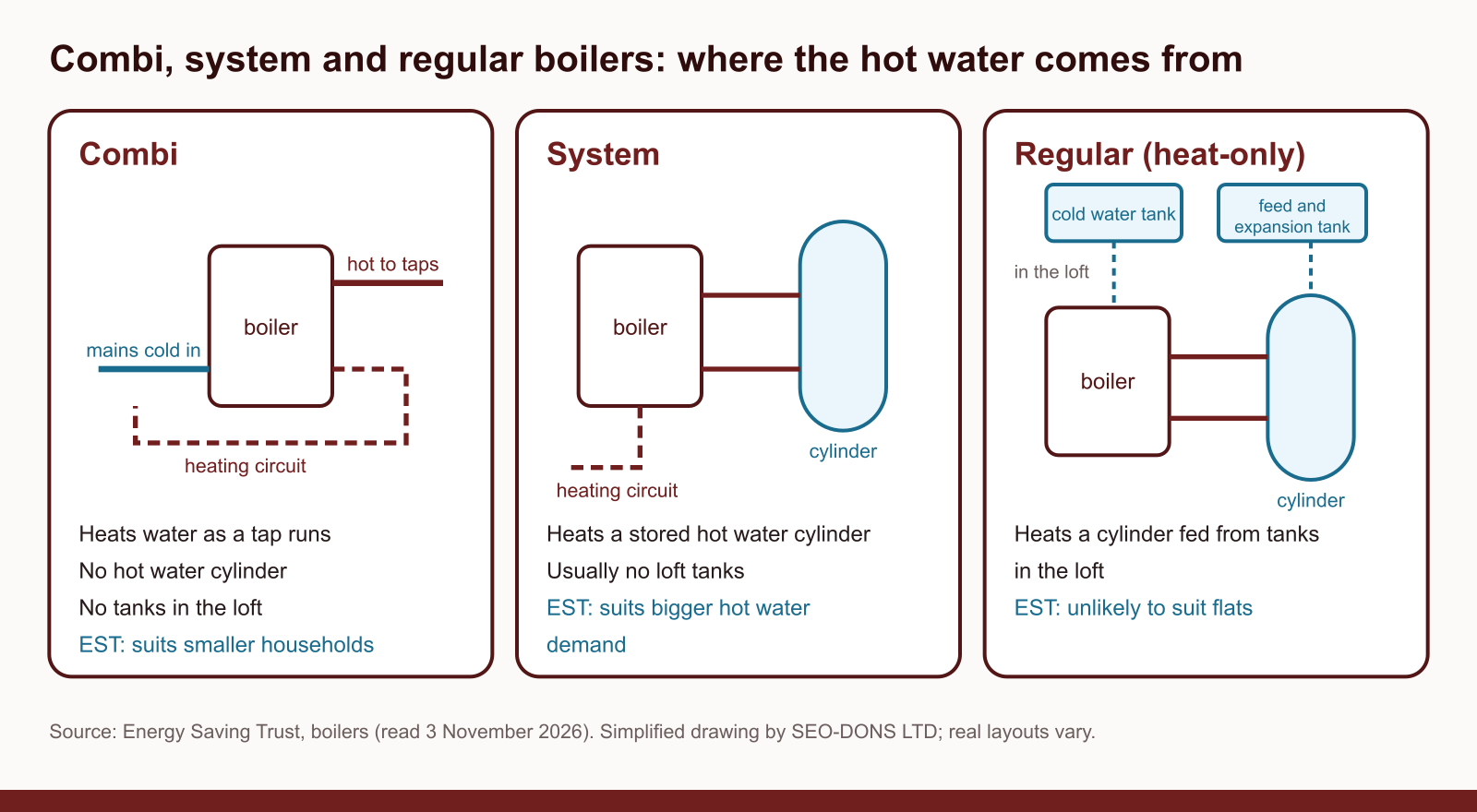
The quickest clue is whether the house stores hot water. Open the airing cupboard, usually on the landing or in a bedroom, and look for a tall cylinder. If there is none, and hot water arrives from the boiler as soon as you open a tap, the house has a combi.
If there is a cylinder, note what it looks like. A copper cylinder, often wrapped in a foam jacket or sprayed with insulation and fed by a pipe from above, is usually a vented one, filled from a tank in the loft. A white or steel cylinder with a small vessel beside it and a cluster of valves and pipes is usually unvented, running at mains pressure. Fitting an unvented cylinder is notifiable work in England, so a correctly installed one should come with its own paperwork.
Either way, the cylinder matters for your quotes. Keeping one now keeps the door open to a heat pump later, because most heat pumps work with a cylinder; our page on hot water cylinders explains the choice.
Second stop
Then look in the loft
With a torch, look for a large cold water storage tank and, nearby, a much smaller tank. The small one is the feed and expansion tank that tops up the heating circuit. Both together mean a regular, or heat-only, boiler on an open-vented system: the boiler heats the radiators and the cylinder, and the loft tanks supply the water.
No tanks in the loft, but a cylinder downstairs, usually means a system boiler: the heating circuit is sealed and pressurised, and the boiler carries the parts that a tank would otherwise do. No tanks and no cylinder points back to a combi.
If you are thinking of changing type, the tanks are part of the job. Taking them out, capping the pipes and sealing the system is work a quote should list. See combi, system or regular for which type suits which home.
What you see, what it means
A quick key to your heating
| What you find | What it usually means | Why it matters for a quote |
|---|---|---|
| No cylinder, hot water straight from the boiler | A combi boiler | A like-for-like swap is another combi; a cylinder is extra work |
| A cylinder and two tanks in the loft | A regular boiler on an open-vented system | Changing to a combi or system boiler means removing tanks |
| A cylinder, no loft tanks, a pressure gauge on the boiler | A system boiler on a sealed system | A cylinder stays; check whether it is vented or unvented |
| A plastic flue and a plastic pipe to a drain | A condensing boiler | The condensate route can usually be reused |
| A metal flue and no condensate pipe | Probably not a condensing boiler | A new condensate route will be part of the job |
| A dial on the wall and valves on each radiator | A room thermostat and thermostatic radiator valves | Shows how much of the control work is already done |
Third stop
At the boiler itself
Without opening anything, read the data badge for the make, the model and the output in kilowatts; it is usually behind a flap or on the underside. A pressure gauge on the front means a sealed system. Then look outside where the flue leaves the wall. The Energy Saving Trust's test for a condensing boiler is a plastic flue rather than a metal one, a plastic pipe from the boiler to a drain, and a gas or LPG boiler fitted after 2005, or an oil boiler after 2007.
Write the output down, but do not let anyone size the new boiler from it alone. England's rules expect the replacement to be sized from a heat loss calculation for the house, and from 24 March 2027 the new edition says sizing it from the old boiler's output is not appropriate. The page on new boiler installation explains how a proper survey does it.
Last stops
The controls and the radiators
List the controls you can see: a timer or programmer, a room thermostat, valves with numbered heads on the radiators, and a thermostat strapped to the cylinder. When a boiler is replaced in England, the rules expect temperature control in each heated room where feasible, separate timing for heating and hot water unless one controller does both, and a boiler interlock. Knowing what is already there shows what a quote should add; heating controls sets out each one.
Finally, count the radiators room by room and note any room that never gets warm. A firm needs both for its heat loss figures, and a whole new system has to be designed to run at 55°C or lower, which can change radiator sizes. More on that in radiators and flow temperature.
Before you ask for quotes
What to write down
- The boiler's make, model, output and roughly how old it is.
- Whether there is a cylinder, and whether it looks vented or unvented.
- Whether there are tanks in the loft.
- The controls you found, and how many radiators each room has.
- How many bathrooms and showers the house has, and how many people use them at once in the morning.
- Anything awkward: a boiler you would like moved, a flue that faces a neighbour, or a listed building.
With that list, every firm quotes for the same job, and the quotes can be set side by side. Comparing heating quotes has a checklist that turns your answers into the lines each quote should show, and you can ask us for a heating quote with the same details.
Look, but leave the covers on
None of this needs a cover off the boiler or the flue. Any work on a gas appliance is for a business on the Gas Safe Register, and the register is the place to check anyone who offers to do it.
Questions about telling what you have
How can I tell if my boiler is a combi?
Look for a hot water cylinder, usually in an airing cupboard. If there is no cylinder and hot water comes straight from the boiler when you run a tap, it is almost certainly a combi.
How do I know if my boiler is a condensing one?
The Energy Saving Trust gives three signs: a plastic flue rather than a metal one, a plastic pipe running from the bottom of the boiler through the wall to a drain, and a gas or LPG boiler fitted after 2005 or an oil boiler fitted after 2007.
Why does it matter what I have now?
Because it decides what a like-for-like replacement is, and what changing type would involve. A quote for a combi in a house that has a cylinder and loft tanks is quoting for a bigger job than a straight swap.
Where do I find the boiler’s make and output?
On the data badge, usually inside the front panel or on the underside of the casing, and in the manual if you still have it. Write down the make, the model and the output in kW for anyone quoting.
Should I touch the boiler to find these things out?
Only look. Do not take covers off the boiler or the flue: any work on a gas appliance is for a business on the Gas Safe Register. The data badge and the pressure gauge can usually be read without opening anything.
Where this page's facts come from
- Energy Saving Trust — boilers (secondary source) read 3 November 2026
- GOV.UK — Approved Document L, Volume 1: dwellings, 2021 edition incorporating 2023 amendments (PDF) read 3 November 2026
- GOV.UK — Approved Document L, 2026 edition (applies from 24 March 2027) read 3 November 2026
- GOV.UK — Approved Document G, with 2024 amendments (PDF) read 3 November 2026
- Gas Safe Register — find and check an engineer read 3 November 2026
Know what you have, and want a price to replace it?
Tell us what you found: whether there is a cylinder or loft tanks, the boiler's make and age, and how many radiators the house has. We reply by email.
What happens next
- Your details go to SEO-DONS LTD, the company behind Heating and Boiler Installation.
- We read what you have sent about the house and its heating, and reply by email.
- Asking for a quote costs nothing and leaves you free to say no.