Replacing a boiler
New boiler installation, from survey to handover
A boiler replacement follows a set order, and much of what matters happens before the old boiler comes off the wall or after the new one is lit. This page follows a typical job in England stage by stage, with the rules that apply at each one.
Last reviewed · facts read at source on 3 November 2026 · published by SEO-DONS LTD · sources
Stage 1
The survey: sizing from heat loss, not from the old boiler
Approved Document L (England, 2021 edition incorporating 2023 amendments) wants a heating appliance chosen on the strength of a heat loss calculation plus a sizing method, and not significantly oversized. A gas combi should be able to modulate, reducing its output to suit the typical heating load of the home.
From 24 March 2027 the 2026 edition takes over, and it closes a familiar shortcut. Even when the appliance is the only thing being replaced, it describes a heat loss calculation covering the whole house as appropriate, and says sizing from the old boiler's output "is not appropriate". It also sets a combi's turn-down target at the typical mid-season heating load.
Before the survey
Know the boiler you have now
First, find out whether your present boiler condenses. The Energy Saving Trust's signs are a plastic flue rather than a metal one, a plastic pipe leaving the underside of the boiler and running out through the wall to a drain, and a gas or LPG boiler fitted after 2005 (an oil boiler after 2007).
Note as well whether it is a combi, a system boiler or a regular boiler fed from tanks in the loft, because changing type changes the job. Combi, system or regular explains which suits which home, and boiler installation cost shows how a change of type moves the price.
Also at the survey
Where the flue can go, and whether planning applies
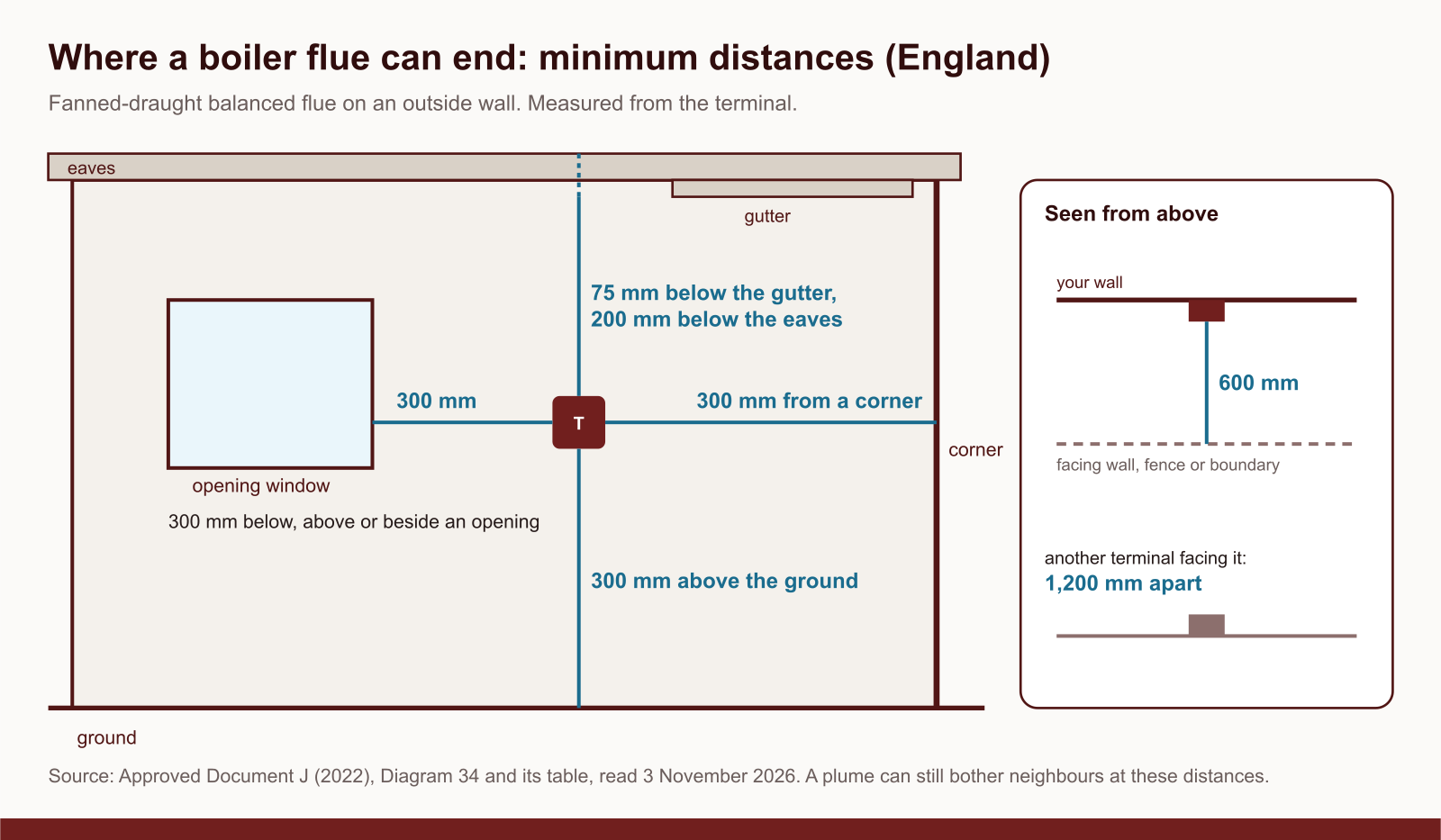
The new boiler's flue terminal has to meet the minimum distances in Approved Document J (England). For a fanned-draught balanced flue they include 300 mm clear of an opening window or air vent and 600 mm from a surface or boundary facing the terminal; the diagram shows the rest. Even at those distances a condensing boiler's plume can sometimes bother neighbours; Approved Document J notes this sits outside the building regulations but could be a statutory nuisance.
Planning permission is not normally needed when all the work is inside, though a listed building should be checked first. An external flue is normally permitted development unless it would rise a metre or more above the roof's highest point. In a conservation area, World Heritage Site, national park, Area of Outstanding Natural Beauty or the Broads, it should not go on a main or side wall that fronts a road. Flues, condensate and CO alarms has the detail.
Stage 2
The quote, and who may do the work
Gas work on a boiler or its pipework may only be done by a business on the Gas Safe Register: the Gas Safety (Installation and Use) Regulations 1998, which cover England, Wales and Scotland, say so in regulation 3, and pretending to be registered is itself an offence. A plumber who is not registered can fit pipes and radiators, but the boiler and the final connection of the water pipes to it need a Gas Safe registered engineer, as HSE makes clear.
Check the ID card of whoever surveys and fits the boiler; according to HSE, its reverse sets out the types of gas work the holder is qualified to do, such as boilers. The quote itself should name the boiler, state its efficiency and spell out the controls, cleaning, flue and alarm. Comparing heating quotes goes through it line by line, and you can get a boiler quote through this site.
Stage 3
The contract and your 14 days
If you sign at home or agree the job online, the Consumer Contracts Regulations 2013 give you a cancellation period that, for a service contract, ends 14 days after the day the contract is made. The firm should not start work in that time unless you expressly ask it to, and for a contract signed at home the request has to be made on a durable medium, such as paper or email.
If you ask for an early start and then cancel, you pay a proportionate amount for what has been supplied; if you were never told of your right to cancel, you pay nothing for the service in that period. Contracts and cancelling covers the rest of your rights.
Stage 4
The fitting day: what goes in alongside the boiler
We found no official figure for how many days a replacement takes, so ask each firm how long yours will need, and how long you will be without heating and hot water. The day itself involves more than hanging a boiler.
- Cleaning the old system. Approved Document L wants the heating circuits thoroughly cleaned and flushed out before the new appliance is fitted, with a suitable chemical inhibitor added after flushing. In hard water areas (above 200 ppm total hardness, as calcium carbonate), a combi also needs scale protection on the water it heats for the taps. See system cleaning.
- The boiler, flue and condensate pipe. The boiler goes on the wall, the flue is fitted on the agreed route and the condensate pipe is run to a drain.
- The controls. When a boiler is replaced, Approved Document L expects thermostatic control in each room where feasible, time control for the heating and hot water, and a boiler interlock so the boiler does not fire when nothing needs heat. A replacement cylinder needs electronic temperature control such as a cylinder thermostat. A new gas combi also needs one of four extra measures: flue gas heat recovery, weather or load compensation, or a smart thermostat with automation and optimisation. See heating controls.
- A carbon monoxide alarm. Approved Document J asks for one in the same room as a new or replacement gas boiler. It should meet BS EN 50291-1:2018, be powered either by a battery built to last the alarm's whole working life or by fixed mains wiring as a Type A alarm (not a plug-in), and sit on the ceiling or high on a wall, between 1 m and 3 m horizontally from the boiler.
Stage 5
Commissioning and handover
Commissioning is the engineer setting the new boiler up and checking it runs as it should. Approved Document L asks for the system to be prepared and commissioned in line with BS 7593, and names the Benchmark Commissioning Checklist as one way to show that commissioning was done. The Benchmark scheme, which dates from 1999, describes its checklist (now also available digitally) as a means of meeting Part L's commissioning requirements.
At handover, ask to see the completed checklist, have the controls explained until you can set them yourself, and keep the manual with the rest of the paperwork.
Stage 6
The paperwork and the 30-day rule
Under the Building Regulations 2010 (Schedule 3), a Gas Safe registered business may self-certify the installation of a gas boiler, and of a heating or hot water system with its controls, so no building notice or full plans are needed in advance. Not more than 30 days after completion, the installer must give you a copy of the compliance certificate and give building control either notice of the work or the certificate.
A firm outside a scheme cannot self-certify: the Planning Portal explains that the firm or the householder must then give the council notice in advance and pay a fee, and the council should issue a completion certificate once the job is done. The rules on this page are England's, and installation rules sets out what changes on 24 March 2027.
Keep these
The paperwork from a boiler replacement
| Document | Who provides it | When | Why it matters |
|---|---|---|---|
| Written contract and cancellation information | The firm | When you agree the job | Fixes the scope and the price, and tells you how to cancel. |
| Benchmark commissioning checklist | The commissioning engineer | At handover | A means of meeting Part L’s commissioning requirements. |
| Compliance certificate (your copy) | The installer, when its business is on the Gas Safe Register | Within 30 days of completion | Evidence that the work complies, short of conclusive proof. |
| Notice to building control | The installer, directly or through the scheme operator | Within the same 30 days | Goes to the council rather than to you. |
| Council completion certificate | The council, where the firm was not in a scheme | After completion | Confirms work that could not be self-certified. |
Keep the set together
Store the set with the boiler manual; the Energy Saving Trust's advice is to keep the building regulations documents for a future sale. If the compliance certificate has not arrived 30 days after the job was finished, ask the installer for it in writing.
Questions about replacing a boiler
Does a replacement boiler need building regulations approval?
Yes, but a business on the Gas Safe Register can self-certify it, so no building notice is needed, and you receive a copy of the compliance certificate within 30 days. A firm outside a scheme must tell the council before the work starts and pay its fee.
How efficient must a new gas boiler be?
In England, at least 92% ErP for gas heating in an existing home, under the current Approved Document L and the 2026 edition alike. The 2021 edition allows a lower SEDBUK figure only in exceptional circumstances. Ask for the efficiency to be stated on the quote.
Can the new boiler simply match the old one’s output?
Not automatically. Approved Document L asks for the boiler to be sized from a heat loss calculation, and the 2026 edition says sizing a replacement from the old appliance’s output is not appropriate. Ask each firm how it worked out the size.
What should the engineer’s Gas Safe ID card show?
The front carries a photograph, the registration number and an expiry date. The reverse shows which kinds of gas work the engineer is qualified to do; for a new boiler, make sure boilers are one of them.
Where this page's facts come from
- legislation.gov.uk — Gas Safety (Installation and Use) Regulations 1998, regulation 3 read 3 November 2026
- HSE — the Gas Safe Register and the engineer ID card read 3 November 2026
- HSE — who can do gas work, and the limits of "wet work" read 3 November 2026
- legislation.gov.uk — Building Regulations 2010, Schedule 3 (self-certification) read 3 November 2026
- legislation.gov.uk — Building Regulations 2010, regulation 20 (compliance certificates) read 3 November 2026
- Planning Portal — boilers and heating: building regulations read 3 November 2026
- Planning Portal — boilers and heating: planning permission read 3 November 2026
- GOV.UK — Approved Document L, Volume 1: dwellings, 2021 edition incorporating 2023 amendments (PDF) read 3 November 2026
- GOV.UK — Approved Document L, 2026 edition (applies from 24 March 2027) read 3 November 2026
- GOV.UK — Approved Document J, 2022 amendments (PDF) read 3 November 2026
- Energy Saving Trust — boilers (secondary source) read 3 November 2026
- Benchmark — the commissioning checklist scheme read 3 November 2026
- legislation.gov.uk — Consumer Contracts Regulations 2013, regulation 36 read 3 November 2026
Planning a boiler replacement?
Tell us the boiler you have now and where it is, whether it heats a hot water cylinder, and what you would like the new one to do. We reply by email.
What happens next
- Your details go to SEO-DONS LTD, the company behind Heating and Boiler Installation.
- We read what you have sent about the house and its heating, and reply by email.
- Asking for a quote costs nothing and leaves you free to say no.