Whole system
Central heating installation: a whole system, new or replaced
A central heating installation covers the whole wet system: the boiler, the pipework, the radiators, the controls and, in many homes, a hot water cylinder. This page is for a home getting central heating for the first time, or having every part of an old system replaced together.
Last reviewed · facts read at source on 3 November 2026 · published by SEO-DONS LTD · sources
The scope
When it is a whole system, not a boiler swap
Most heating jobs replace one part and keep the rest. A central heating installation is different: either the home has no wet system yet, or the boiler, radiators and pipework are all being replaced together. Approved Document L (England) treats a newly installed or fully replaced wet system as one design, from the appliance to the emitters and the pipes that join them.
Every part depends on the others. Each room's heat loss decides how large its radiator must be at the chosen flow temperature, and the household's use of hot water decides between a combi and a cylinder. If only the boiler is changing, read new boiler installation instead; if you are still choosing the boiler, start with combi, system or regular.
The design rule
Radiators sized for a 55°C flow
For a new or fully replaced system, Approved Document L asks for the appliance, emitters and pipework to be sized so the home can be heated with a flow temperature no higher than 55°C, or the lowest design temperature that is feasible. The edition that takes over on 24 March 2027 keeps that requirement. The boiler itself should be chosen using a heat loss calculation and should not be significantly oversized.
Radiators designed for 55°C are often larger than those in older systems that ran hotter, so expect the radiator schedule to look different from what came out. Radiators and flow temperature explains the rule in more depth, and boiler or heat pump covers the longer-term choice of heat source.
The parts
How the pieces of a wet system fit together
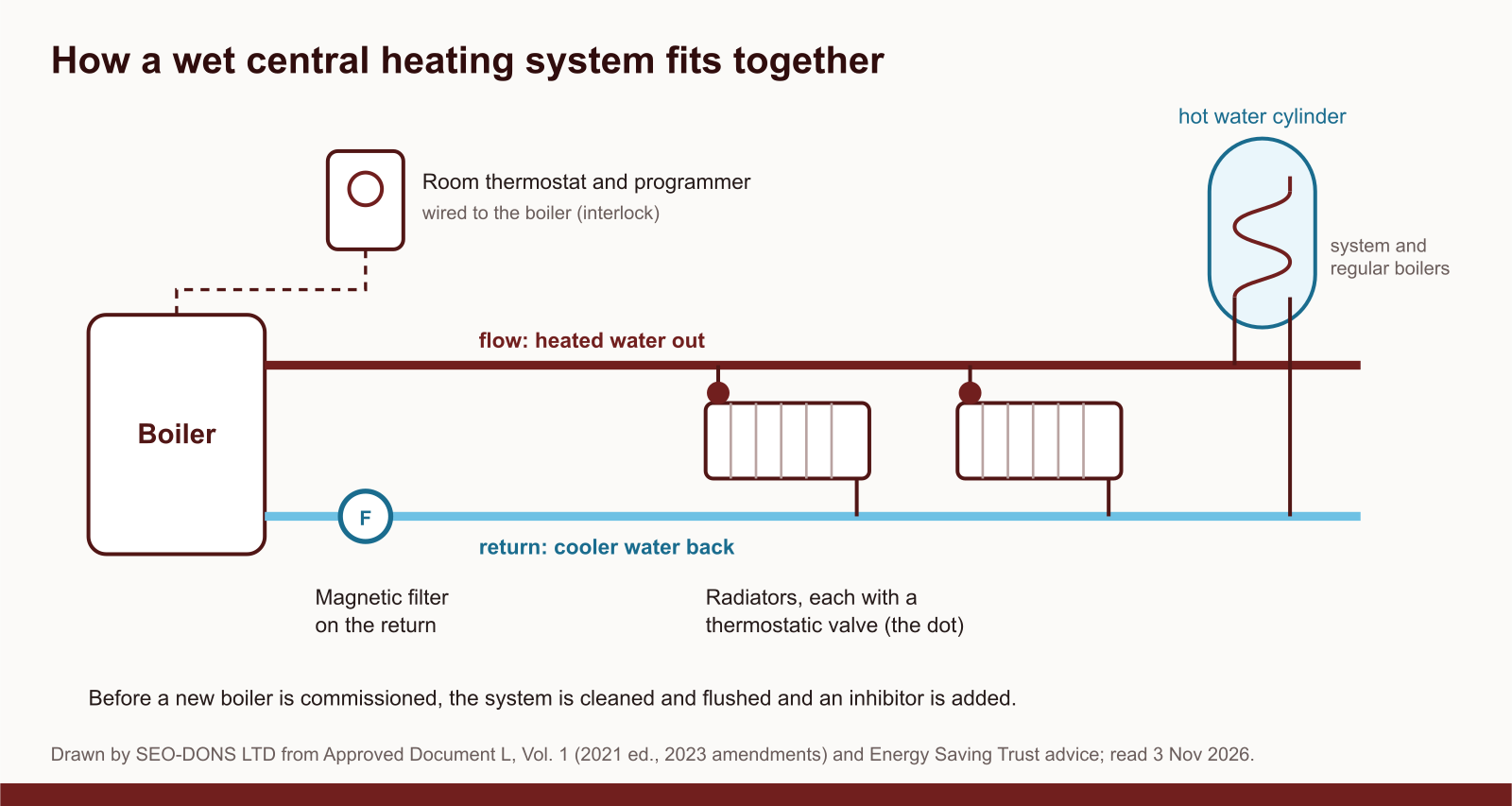
Every wet system is a loop. The boiler heats water, which is pumped out along the flow pipe, gives up its heat in the radiators and comes back cooler along the return to be heated again. With a system or regular boiler, the same loop also heats a coil inside the hot water cylinder.
Pipework is easy to overlook in a quote. A first-time installation needs new runs to every room, and the route decides how much floor is lifted and what is boxed in, so agree it before work starts. A magnetic filter on the return catches iron particles carried in the water; the Energy Saving Trust notes that building regulations encourage these filters, and that one should be added when a boiler is replaced if the system lacks one. Each radiator gets a thermostatic valve, and a room thermostat and programmer are wired to the boiler so it fires only when there is a demand for heat.
The trades
Who may do which part of the job
A whole system often involves more than one trade, and the law draws a firm line at the boiler.
| Part of the job | Who may do it | Worth knowing |
|---|---|---|
| Laying pipework and fitting radiators | A plumber or heating engineer; this wet work does not need Gas Safe registration | HSE confirms that someone who is not registered may install water pipes and radiators. |
| Fitting the gas boiler | An engineer from a business on the Gas Safe Register | Regulation 3 of the 1998 gas regulations requires it. Check that the ID card lists boilers. |
| Connecting the water pipework to the boiler | A Gas Safe registered engineer | HSE treats this final connection as part of the boiler work, not the plumbing. |
| An unvented hot water cylinder | A member of a competent person scheme for unvented systems, or someone with a current unvented hot water skills card | Fitting one is notifiable building work under Approved Document G. A scheme member self-certifies, and you get a compliance certificate, usually from the scheme operator. |
| Self-certifying the heating system | A Gas Safe registered business, for a heating or hot water system and its controls | No building notice is needed beforehand; your copy of the compliance certificate is due within 30 days of completion. |
One contract, or several?
If the plumbing and the gas work come from different firms, agree in writing who designs the system, who commissions it and who issues each certificate. HSE warns that a Gas Safe engineer who knowingly signs off gas work done by an unregistered person exposes both of them to prosecution.
Controls
Zones, timers and control in each room
A new system is the easiest moment to get the controls right, because the wiring and valves go in with everything else. A full replacement includes a new boiler, so Approved Document L (England) applies its replacement rules: a thermostatic control setting the temperature of each room where feasible, timing for both heating and hot water, and an interlock that stops the boiler firing when there is no demand for heat. A replacement cylinder needs its own electronic temperature control, a cylinder thermostat for example. A home getting central heating for the first time is worth designing to the same standard from the outset.
Zoning goes a step further, splitting the house into areas such as upstairs and downstairs, each with its own timing and temperature. Ask the firms quoting how they would zone your home, and why. Heating controls sets out the options, including the extra measure a new gas combi needs.
Hot water
A cylinder, or a combi?
The Energy Saving Trust's rule of thumb is that combis suit smaller households, while system boilers, which feed a hot water cylinder, suit homes with a larger demand for hot water. It adds that heat-only boilers are unlikely to suit flats, and that because most heat pumps rely on a cylinder, choosing a combi now may mean refitting one if you move to a heat pump later.
Installing an unvented cylinder, which runs at mains pressure, is notifiable building work under Approved Document G (England). The installer shows competence through a competent person scheme that covers unvented systems, or a current registered operative skills card for them. Hot water cylinders compares the types in detail.
Finishing
Cleaning, commissioning and the certificate
Even brand-new pipework is prepared before the boiler runs. Approved Document L wants the circuits flushed and cleaned thoroughly before a new heating appliance is fitted, then dosed with a suitable inhibitor, with the system prepared and commissioned to BS 7593; in a hard water area, the feed to a combi's hot water side should also be protected against scale. System cleaning and water treatment explains what that involves.
The Benchmark Commissioning Checklist can be used to record the commissioning. If a Gas Safe registered business installed the system, it can self-certify, and within 30 days of completion you should be handed a copy of the compliance certificate while building control receives notice of the work. Keep both with the home's papers: the Energy Saving Trust advises holding on to building regulations documents for when you sell.
Getting a whole system quoted
We know of no published benchmark for a full system that this site can cite. The one average used here, the Energy Saving Trust's £3,500, covers the replacement of a G-rated gas boiler by an A-rated model, with thermostatic radiator valves, so it says little about a job that adds new radiators and pipework throughout. Boiler installation cost explains what moves a price.
Ask at least three firms, as the Energy Saving Trust suggests, and give each the same brief: the rooms to heat, the hot water the household uses and whether you want a combi or a cylinder. Each quote should list every radiator with its size and the heat it gives out at the design flow temperature, the pipe routes, the controls and the paperwork. When the quotes come back, comparing heating quotes helps you set them side by side; to start the process, get a heating quote.
Questions about installing central heating
Does every room need its own thermostat?
Not necessarily a separate thermostat. When a boiler is replaced, Approved Document L (England) expects thermostatic control of each room where it is feasible; one accepted arrangement is a single room thermostat, with thermostatic radiator valves controlling the other rooms.
How is a full system different from replacing just the boiler?
A full system replaces the boiler, radiators and pipework together, so they are designed as one. In England that brings in the 55°C design rule, under which the whole system is sized so the water leaving the boiler need be no hotter than 55°C, or the lowest design temperature that is feasible. A boiler-only replacement usually keeps the existing radiators and pipes.
Does new central heating need a hot water cylinder?
Only if the boiler you choose works with one. A combi heats water as it is used, while system and regular boilers store it in a cylinder. The Energy Saving Trust suggests combis for smaller households and system boilers where the demand for hot water is larger.
Who signs off a new central heating system?
If a business on the Gas Safe Register installed it, that business can self-certify the work under the Building Regulations 2010, so no building notice is needed. Within 30 days of completion it must hand you a copy of the compliance certificate and tell building control about the work.
Does brand-new pipework need flushing?
Yes. In England, Approved Document L expects the circuits to be flushed out and cleaned before any new heating appliance goes in, then protected with a suitable inhibitor.
Where this page's facts come from
- GOV.UK — Approved Document L, Volume 1: dwellings, 2021 edition incorporating 2023 amendments (PDF) read 3 November 2026
- GOV.UK — Approved Document L, 2026 edition (applies from 24 March 2027) read 3 November 2026
- HSE — who can do gas work, and the limits of "wet work" read 3 November 2026
- legislation.gov.uk — Gas Safety (Installation and Use) Regulations 1998, regulation 3 read 3 November 2026
- legislation.gov.uk — Building Regulations 2010, Schedule 3 (self-certification) read 3 November 2026
- legislation.gov.uk — Building Regulations 2010, regulation 20 (compliance certificates) read 3 November 2026
- GOV.UK — Approved Document G, with 2024 amendments (PDF) read 3 November 2026
- Energy Saving Trust — boilers (secondary source) read 3 November 2026
Want a whole heating system priced?
Tell us whether the home has central heating now, how many rooms and bathrooms it has, and whether you would like a combi or a hot water cylinder. We reply by email.
What happens next
- Your details go to SEO-DONS LTD, the company behind Heating and Boiler Installation.
- We read what you have sent about the house and its heating, and reply by email.
- Asking for a quote costs nothing and leaves you free to say no.