Heating controls
Heating controls the rules require, and the four combi options
A boiler only runs as well as the controls telling it when to fire and how hot to make the water. This page lists the controls England's rules expect when a boiler is replaced, explains the four options a new gas combi must choose from, and shows what a quote should name.
Last reviewed · facts read at source on 3 November 2026 · published by SEO-DONS LTD · sources
Part of the job
The controls belong to the boiler installation
It is easy to think of the thermostat and programmer as extras to sort out later. England's Approved Document L sees it differently: paragraph 5.27 of the 2021 edition, with its 2023 amendments, treats the boiler's controls as part of the boiler installation. So the controls should sit on the same quote as the boiler, named and priced, rather than being left as whatever happens to be on the wall.
The requirements began with Boiler Plus, a set of standards introduced in England in April 2018. Boiler Plus required time and temperature controls and a boiler interlock with every new gas or oil boiler fitted in an existing home, and it gave gas combis a further requirement of their own. Those standards are now carried in the 2021 edition of Approved Document L, which came into force on 15 June 2022.
Interlock
What a boiler interlock does
An interlock is not a gadget on the wall; it is how the controls are wired. With one in place, the boiler fires only when a thermostat is calling for heat, whether for the rooms or for stored hot water, and stays off when nothing is. Without it, a boiler can carry on cycling to heat water that no room has asked for.
Boiler Plus requires an interlock with every new gas or oil boiler in an existing home, and paragraph 5.25 of Approved Document L asks for one when a boiler is replaced. Because it is a matter of wiring rather than a product, it may not appear as a line of its own, so ask the installer to confirm in writing that the new controls provide it.
The list
Which controls are required, and when
| Control | What it does | When England expects it |
|---|---|---|
| Time control | A timer or programmer that sets when the heating, and any stored hot water, comes on | With every new gas or oil boiler in an existing home (Boiler Plus) |
| Temperature control | Usually a room thermostat, which stops calling for heat once the room is warm enough | With every new gas or oil boiler in an existing home (Boiler Plus) |
| Boiler interlock | Wiring that keeps the boiler off when no thermostat is calling for heat | With every new gas or oil boiler (Boiler Plus), and when a boiler is replaced (paragraph 5.25) |
| Thermostatic control in each room | Lets each room be held at its own temperature, for example with thermostatic radiator valves | When a boiler is replaced, where feasible (paragraphs 5.20 and 5.22) |
| Separate timing for heating and hot water | Lets the hot water follow its own schedule | When a boiler is replaced, unless one controller already does both (paragraph 5.24) |
| Cylinder thermostat | Electronic temperature control that stops the stored water being heated once it is hot enough | When a hot water cylinder is replaced (paragraph 5.26) |
| One of the four combi measures | Helps a combi burn less gas; the options are explained below | When a gas combi is fitted in an existing home (paragraph 6.2, and 5.9 in the 2026 edition) |
The combi rule
The four combi options, in plain words
A gas combi fitted in an existing home in England needs at least one of the following. The rules treat them as alternatives, so any one of them meets the requirement, and which one suits depends on the boiler, the system and how the house is used.
Flue gas heat recovery
The gases leaving a condensing boiler's flue still hold some heat. A flue gas heat recovery unit captures part of it and uses it to warm the cold water coming in, so the boiler has less to do when a hot tap runs. Some boilers have one built in; others take a separate unit fitted to the flue.
Weather compensation
Weather compensation adjusts to the temperature outside, usually measured by a sensor on an outside wall. On a mild day the boiler sends cooler water to the radiators, and on a cold day hotter water, instead of heating to one fixed temperature all winter. Set up well, it keeps the boiler running at lower temperatures for more of the year.
Load compensation
Load compensation watches the room instead of the weather. As a room gets close to the temperature you have set, the controls ask the boiler for cooler water, so it eases off gradually rather than switching fully on and off.
A smart thermostat with automation and optimisation
The rule names two functions, so a thermostat whose main feature is control from a phone app is not what it describes. Optimisation usually means features such as working out how early to start the heating so the house is warm on time. Ask the installer which functions the model has, and get the answer on the quote.
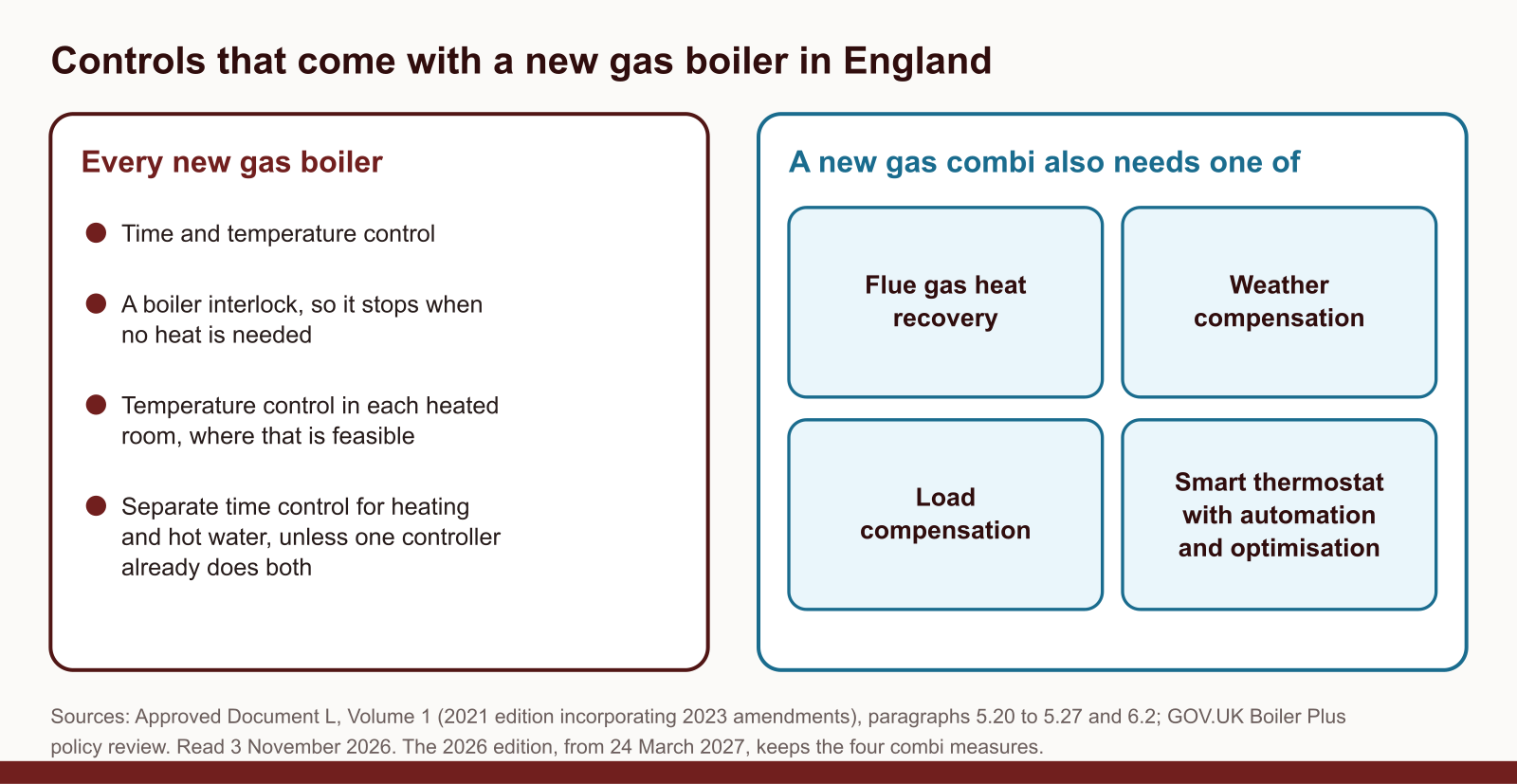
The 2026 edition of Approved Document L, published in March 2026, revised in September 2026 and applying from 24 March 2027, keeps the same four measures at its paragraph 5.9, so a combi fitted after that date faces the same choice.
Room by room
Thermostatic control in each room
When a boiler is replaced, paragraph 5.20 asks for every room to be given thermostatic room controls, so that each can be kept at its own temperature, unless that is not feasible. Paragraph 5.22 gives a familiar way of meeting it: a room thermostat in one room and thermostatic radiator valves on the radiators in the others.
Valves are worth checking on every quote. One firm may count a new valve for every radiator; another may keep the old ones. If old valves are staying, ask whether they still move, because a valve stuck open controls nothing. The radiators and flow temperature page explains how the radiators themselves are sized.
Stored hot water
Extra controls where there is a cylinder
System and regular boilers heat a cylinder, and that brings two more controls into play. Replace the boiler and the heating and hot water should be timed separately (paragraph 5.24), unless a single controller already does both. Replace the cylinder and it should get electronic temperature control, such as a cylinder thermostat (paragraph 5.26).
A combi has no cylinder, so the cylinder thermostat never comes into it; its extra requirement is the four-option rule above. If you are still choosing between the types, the boiler types page puts them side by side, and hot water cylinders covers the cylinder in detail.
On the quote
What the controls line on a quote should say
- The make and model of each control, not just the word "controls".
- For a combi, which of the four measures is included, and why that one suits the house.
- How many thermostatic radiator valves are included, and whether any old ones are being kept.
- That the wiring will give a boiler interlock.
- For a cylinder system, how the heating and hot water will be timed, and whether the cylinder has a thermostat.
- Who will set the controls up on the day and show you how to use them.
Lay your quotes side by side with the quote comparison checklist, and if a firm says a control is not needed in your home, ask for the reason in writing. For everything else a replacement must meet, see what the rules require; for what happens on the day, see new boiler installation; and for the price of the job as a whole, see boiler installation cost. Once you know which controls you want, get a heating quote that names them.
Questions about heating controls
Do oil boilers need the same controls as gas boilers?
Partly. Boiler Plus requires time and temperature controls and a boiler interlock with every new gas or oil boiler fitted in an existing home in England. The four-option rule, though, is written for gas combis, so it is not part of the requirement for an oil boiler.
Is one of the four combi options better than the others?
The rules do not rank them: any one of the four meets the requirement. Which suits depends on the boiler, the system and how the house is used, so ask the installer to name the option included and explain why it fits your home.
Can the combi measure be added after the boiler is fitted?
It should come with the boiler. Paragraph 6.2 applies when a gas combi is installed in an existing home, and paragraph 5.27 treats the boiler’s controls as part of the boiler installation, so the measure belongs on the same quote and the same job rather than being left for later.
What does a smart thermostat need to count as the combi measure?
Both automation and optimisation functions, because that is how the rule is worded. A thermostat whose main selling point is control from a phone may not qualify on that alone, so ask for the model’s functions in writing before accepting it as the combi measure.
Do the control rules change on 24 March 2027?
Not for the combi measures. The 2026 edition of Approved Document L, which applies in England from that date, keeps the four options at its paragraph 5.9 and the 92% ErP floor for gas boilers in existing homes. Until then the 2021 edition, with its 2023 amendments, is the one that applies.
Where this page's facts come from
- GOV.UK — Approved Document L, Volume 1: dwellings, 2021 edition incorporating 2023 amendments (PDF) read 3 November 2026
- GOV.UK — Approved Document L, 2026 edition (applies from 24 March 2027) read 3 November 2026
- GOV.UK — Boiler Plus policy review (PDF) read 3 November 2026
Get a quote for new heating controls
Tell us which boiler you have, which controls are on the wall now and roughly how many radiators the house has, and whether you want the controls quoted alone or with a new boiler. We reply by email.
What happens next
- Your details go to SEO-DONS LTD, the company behind Heating and Boiler Installation.
- We read what you have sent about the house and its heating, and reply by email.
- Asking for a quote costs nothing and leaves you free to say no.