Boiler types
Combi, system or regular boiler: which suits which home
All three kinds of gas boiler heat the radiators; they differ over hot water, which decides whether a home keeps a cylinder, loft tanks or neither. This page shows how each type works, which households each suits and what England's rules ask of each.
Last reviewed · facts read at source on 3 November 2026 · published by SEO-DONS LTD · sources
Start from what you have
Work out what heats the house now
Most replacements start from the boiler already on the wall, and the clues are easy to read. A hot water cylinder in an airing cupboard points to a system or regular boiler; no cylinder anywhere in the house usually means a combi. If there is a cylinder, look in the loft. A cold water storage tank, with a smaller feed and expansion tank beside it, points to a regular boiler, while a cylinder with nothing in the loft usually belongs to a system boiler.
It also helps to know whether the current boiler is a condensing one. The Energy Saving Trust gives three signs: the flue is plastic, where a metal flue suggests it is not condensing; a plastic pipe runs from the bottom of the boiler through the wall to a drain; and it is a gas or LPG boiler fitted after 2005, or an oil boiler fitted after 2007. If yours shows none of those signs, expect the quote for its replacement to include a condensate pipe and a route to a drain, which the old boiler never needed.
Common ground
What every new gas boiler in England must do
Whatever the type, the rules start in the same place. Boiler Plus, introduced in England in April 2018 and now carried in Approved Document L, sets a floor of 92% ErP efficiency for a gas boiler fitted in an existing home. Only in exceptional circumstances does the guidance accept less, using the older SEDBUK 2009 measure: 78% for natural gas or 80% for LPG.
Every new gas or oil boiler in an existing home must also come with time and temperature controls and a boiler interlock. One rule separates the types, and it applies to combis alone: a gas combi needs at least one of flue gas heat recovery, weather compensation, load compensation, or a smart thermostat with automation and optimisation. Each option is explained on the heating controls page. The 2026 edition of Approved Document L, which applies from 24 March 2027, keeps both the 92% floor and the four combi measures.
Side by side
Combi vs system boiler vs regular, at a glance
| What to compare | Combi | System boiler | Regular (heat-only) |
|---|---|---|---|
| Where the hot water comes from | Heated by the boiler as a tap runs | Heated ahead of time and stored in a cylinder | Heated ahead of time and stored in a cylinder |
| Hot water cylinder | None | Yes | Yes |
| Tanks in the loft | None | Usually none | A cold water storage tank and a feed and expansion tank |
| What the Energy Saving Trust says it suits | Smaller households | Homes with bigger hot water demand | Unlikely to suit flats |
| Minimum efficiency for a new gas boiler in an existing home | 92% ErP | 92% ErP | 92% ErP |
| Extra rule for a new gas boiler | At least one of four efficiency measures | None beyond the general rules | None beyond the general rules |
| If a heat pump may come later | Most heat pumps work with a cylinder, so one may have to be fitted | A cylinder is already part of the layout | A cylinder is already part of the layout |
Thinking about a heat pump later?
The Energy Saving Trust points out that most heat pumps work with a hot water cylinder. Taking a cylinder out to fit a combi today can therefore mean putting one back if you switch to a heat pump in future. If that switch is a real possibility, mention it when you ask for quotes, ask whether the cylinder you have would suit a heat pump, and read boiler or heat pump before you decide.
How each one works
The three layouts in a real house
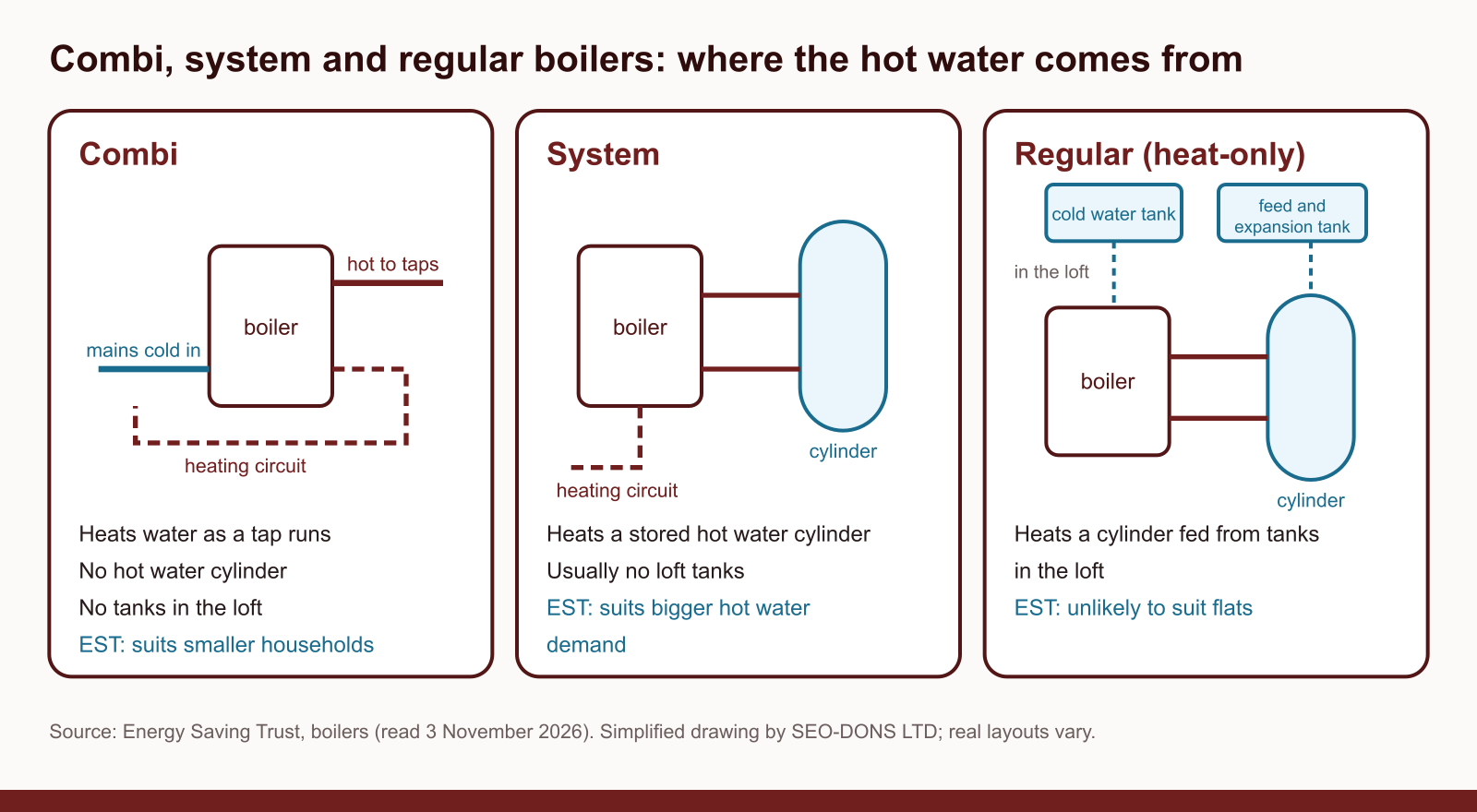
Combi
A combination boiler does two jobs from one box: it runs the heating circuit, and when a hot tap opens it heats mains water as it passes through. Nothing is stored, so there is no cylinder to keep warm. The limit is how much water it can heat at any one moment, which matters most when several taps or showers run together; hence the Energy Saving Trust's view that combis suit smaller households.
System boiler
A system boiler heats the radiators and a hot water cylinder, so a store of hot water is ready before anyone turns a tap. Several outlets can draw on that store at the same time, which is why the Energy Saving Trust suggests a system boiler where hot water demand is bigger. The cost is space: the cylinder needs a cupboard, and the water in it is heated to a schedule rather than on demand.
Regular (heat-only) boiler
A regular boiler, also sold as heat-only or conventional, works with a cylinder as well, but the cylinder is filled from the loft rather than straight from the mains. A cold water storage tank feeds the cylinder, and a smaller feed and expansion tank keeps the heating circuit topped up. It is the arrangement found in plenty of older houses. The Energy Saving Trust considers a heat-only boiler unlikely to suit a flat, which makes sense given how much of the arrangement sits in a loft.
Changing type
Switching types makes it a bigger job
Replacing like with like, in the same spot, is the simplest kind of boiler change. A change of type reaches further into the house. Moving from a regular or system boiler to a combi takes the cylinder out (and the loft tanks too, for a regular boiler), and the pipework is altered so the taps are fed through the new boiler. Going the other way means finding room for a cylinder and its pipework.
A change of type touches the hot water, the controls and sometimes the radiators, so read central heating installation for jobs that replace more of the system and hot water cylinders for the cylinder itself. Ask for each extra piece as its own line on the quote, so that comparing quotes line by line works.
Sizing
Size it from the house, whatever the type
The type decides where the hot water comes from; the size decides how well the boiler runs. In England, Approved Document L asks for heating to be specified from an appropriate heat loss calculation and a sizing method, and not to be significantly oversized. For a gas combi it adds that the boiler should be able to modulate, or turn its output down, to the home's typical heating load.
The 2026 edition, which applies from 24 March 2027, goes further. Where only the heating appliance is replaced, it says a heat loss calculation for the whole dwelling is appropriate, and that sizing the replacement from the heat output of the boiler already installed is not. It also asks a combi to turn down to the typical mid-season heating load. A quote that copies the old boiler's kW figure deserves a question now, and more so once the new edition applies. The radiators and flow temperature page explains how the radiators fit into the same calculation.
Choosing
Five questions that usually settle it
- Is the home a flat, or a house with a loft that can take tanks? A heat-only boiler is unlikely to suit a flat.
- Is the household small, or does it get through a lot of hot water? Combis suit smaller households; system boilers suit bigger demand.
- Could a heat pump replace this boiler one day? Most heat pumps work with a cylinder, so think twice before removing one.
- Is the current boiler condensing, and if not, where will a condensate pipe run?
- Has anyone worked out the home's heat loss, or is the new boiler's size being copied from the old one?
With those answers in hand, get a boiler quote and tell us which type you have now and which you are leaning towards. For the one cost benchmark this site relies on, see boiler installation cost; for how the work runs on the day, see new boiler installation; and for the full set of requirements, see the installation rules.
Questions about boiler types
Do I have to replace my boiler with the same type?
No. England’s building regulations set efficiency and control standards for a new boiler, not which type it has to be, so the choice rests on the household, the space and whether a heat pump might follow. Expect a change of type to add work, and ask for that work to be priced line by line.
Does a system or regular boiler need one of the four combi measures?
No. The extra measure (flue gas heat recovery, weather compensation, load compensation, or a smart thermostat with automation and optimisation) is required for a gas combi fitted in an existing home in England. A gas system or regular boiler still has to reach 92% ErP and come with time and temperature controls and a boiler interlock, and you can choose one of the four measures for it anyway.
How can I tell if my current boiler is a condensing one?
Check the flue and the pipework underneath. The Energy Saving Trust treats a plastic flue as a sign of a condensing boiler and a metal one as a sign that it is not, and a plastic pipe leading from the bottom of the boiler out to a drain points the same way. Its third clue is age: a gas or LPG boiler fitted after 2005, or an oil boiler fitted after 2007.
What happens to the cylinder and loft tanks if I switch to a combi?
They normally come out, and the pipework is altered so the taps are fed through the combi. Before agreeing, weigh up the Energy Saving Trust’s point that most heat pumps work with a hot water cylinder: if a heat pump could follow, you may end up fitting a cylinder again.
Which of the three types is the most efficient?
The rules do not favour one. Any new gas boiler fitted in an existing home in England, whatever its type, must reach at least 92% ErP. Above that floor, correct sizing, good controls and careful set-up make a real difference to how a boiler runs, so compare those as closely as the type itself.
Where this page's facts come from
- Energy Saving Trust — boilers (secondary source) read 3 November 2026
- GOV.UK — Boiler Plus policy review (PDF) read 3 November 2026
- GOV.UK — Approved Document L, Volume 1: dwellings, 2021 edition incorporating 2023 amendments (PDF) read 3 November 2026
- GOV.UK — Approved Document L, 2026 edition (applies from 24 March 2027) read 3 November 2026
Get a boiler quote for the type that suits your home
Tell us which type of boiler the house has now, whether there is a cylinder or tanks in the loft, and which type you would like quoted. We reply by email.
What happens next
- Your details go to SEO-DONS LTD, the company behind Heating and Boiler Installation.
- We read what you have sent about the house and its heating, and reply by email.
- Asking for a quote costs nothing and leaves you free to say no.